
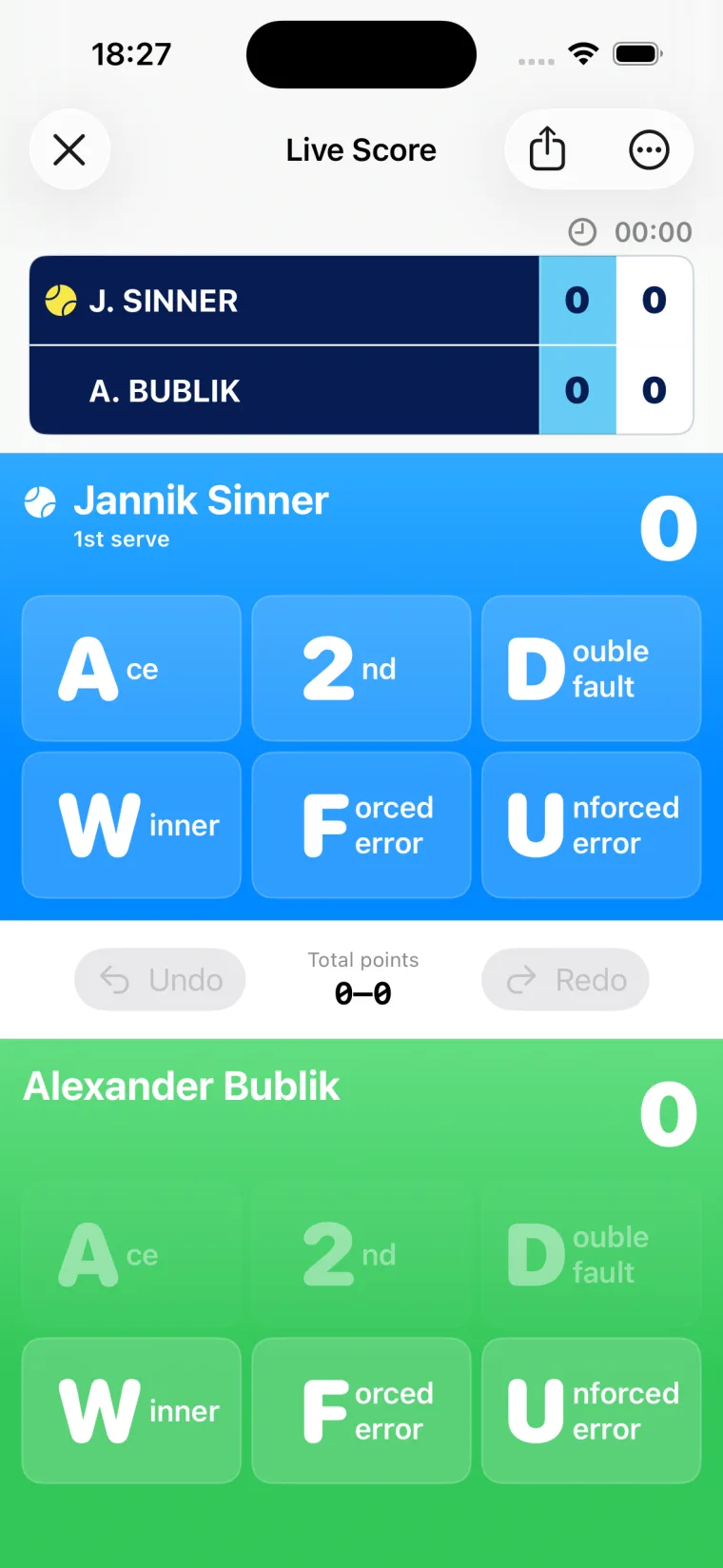
Traditional scoring starts with a result: who won the point? Advanced Point Tracking starts with the moment itself: who hit the winner, served the ace or made the error?
That small change makes detailed scoring feel more natural. Each player has their own panel. Tap the action inside the panel of the player who performed it, and the score follows automatically.
Tap the actor, not the consequence.
Imagine Player A sends a routine forehand long. Tap Unforced error in Player A’s panel. Match Update records the error against Player A and gives the point to Player B.
If Player A hits a winner, tap Winner in the same panel and the point goes to Player A. An ace goes to the server. A double fault goes to the receiver. You identify what happened and who did it, without mentally translating the action into a separate scoring decision.
When this helps
Use Advanced Point Tracking when you want richer statistics but still need to keep your attention on the court. One direct choice records both the point and its meaning.
One tap on iPhone and iPad.
The larger scoring screen keeps the six actions visible inside each player’s panel: Ace, second serve, double fault, winner, forced error and unforced error. For a completed point, one tap is enough to record the outcome and update the tennis score.
A first-serve fault is the natural exception because the point is still in progress. Tap 2nd on the server’s side, then record the eventual outcome after the second serve.
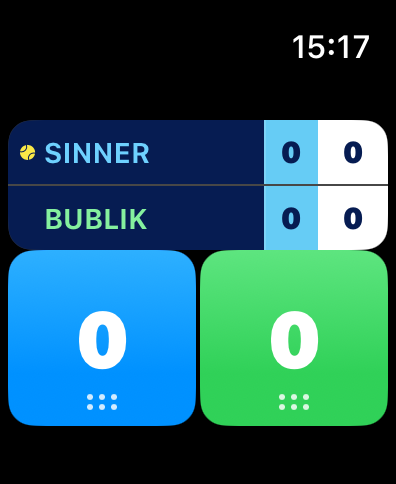
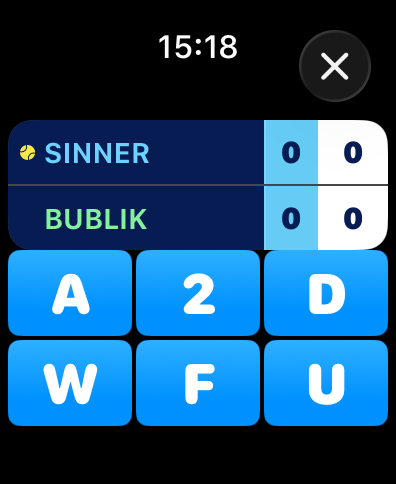
Two quick taps on Apple Watch.
The Watch uses the same actor-first idea in a smaller space. Tap the player who performed the action, then tap the outcome. Match Update applies exactly the same scoring logic and returns you to the match.
Advanced tracking still asks for more observation than basic scoring, but it avoids unnecessary steps. You do not record the story and then separately award the point. The story is the score input.