
A final score describes one match. Player Development asks a different question: what has the recorded history been doing over time? It brings the useful parts of many matches into one personal view without turning a single number into a verdict.
Start with the shape of your game.
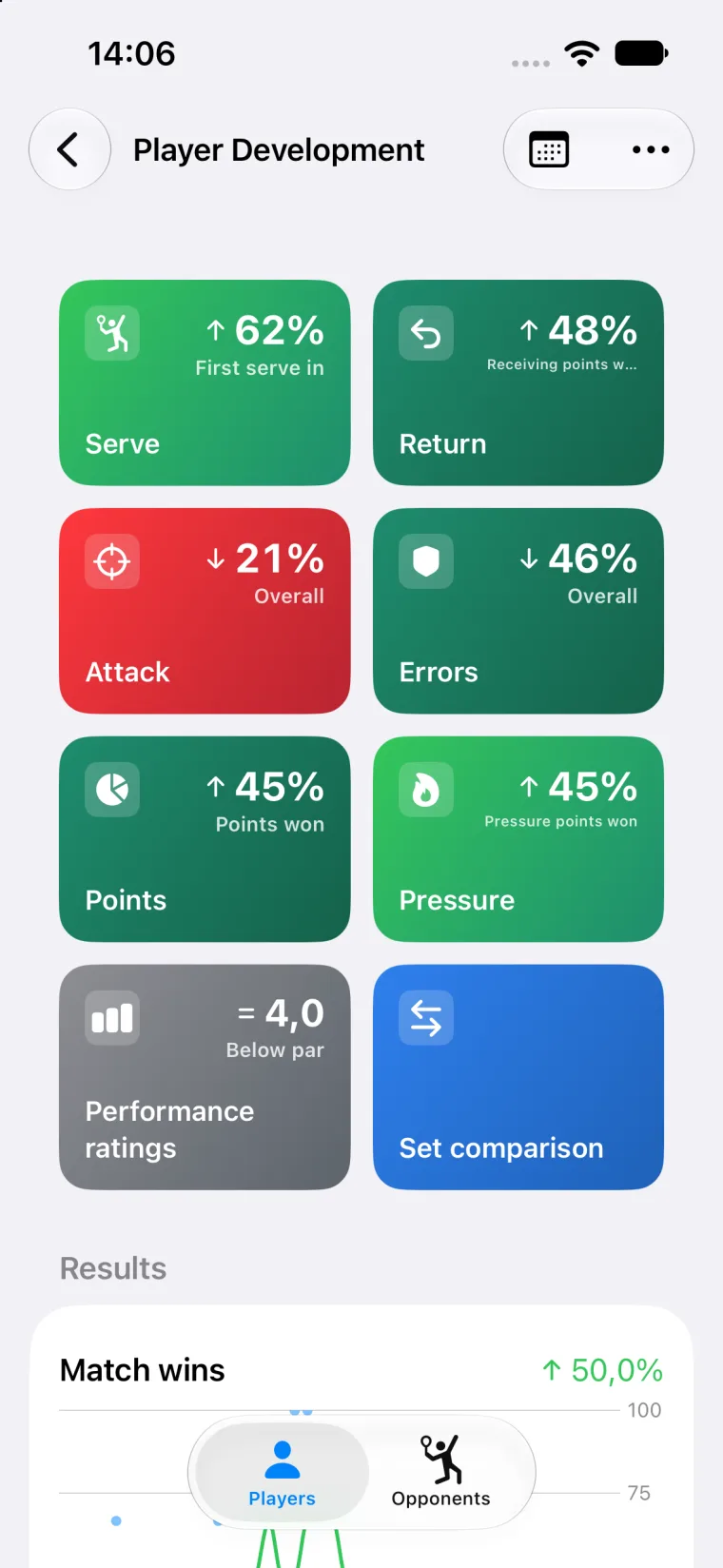
The overview organizes the available evidence into Serve, Return, Attack, Errors, Points, Pressure and Performance ratings. Each tile uses one clearly labelled measure for the selected period, so you can see where to look next instead of averaging unrelated parts of the game.
Green means the recorded direction improved, red or orange means it deteriorated and gray means neutral or insufficient evidence. For errors, a lower value is an improvement even though the numerical arrow points down.
When this helps
Open Player Development before a coaching conversation, after a block of matches or when a result feels different from the longer pattern. It helps you choose a useful question, such as whether the first serve is becoming more reliable or pressure points are moving in the same direction as the overall game.
Choose the time window that fits the question.
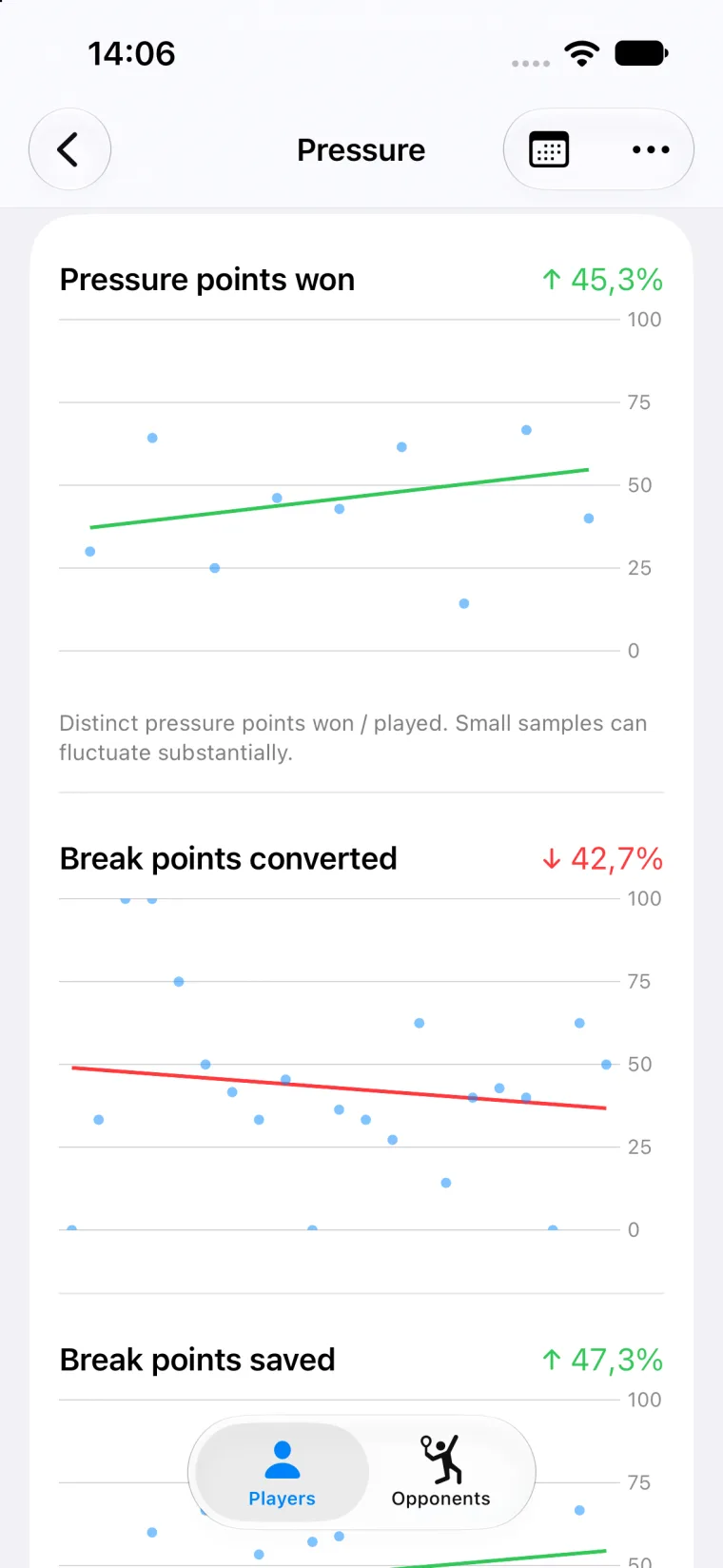
Use the complete history, a calendar year, the last six or three months, or the last month. Every chart filters its own usable matches inside that period. A dot represents one match, and the optional straight trend line describes the full selected period when enough eligible evidence is available.
Select a dot to see its date and value. Missing evidence stays missing rather than becoming a recorded zero, so different charts can legitimately contain different matches.
Every metric available over time.
The exact selection depends on the sport and the evidence recorded in each match. This is the complete set currently available in Player Development.
Serve
First serve in, second serve in, service fault rate, ace rate, service points won, first-serve points won and second-serve points won.
Sport-specific. Tennis Doubles and Padel use attributed personal service evidence.Return
Receiving points won, points won returning first serves and points won returning second serves.
Singles only. Serve-number splits apply to Tennis Singles.Attack
Overall attacking output, winners, opponent forced errors and attack–error balance.
All sports. Doubles and Padel show personal winners and balance without assigning opponent errors.Errors
Overall committed errors, unforced errors and forced errors committed.
All sports. Doubles and Padel use only the selected player’s attributed errors.Points
Points won, points won serving, points won receiving, and serving and receiving contributions to points won.
Singles only.Pressure
Pressure points won, break points converted and saved, set and match points converted, tiebreak points won, game points converted, plus errors, winners and service faults under pressure.
The available measures follow the sport. Doubles and Padel use personal actions under pressure.Performance ratings
Overall, Serve, Return, Attack, Control and Pressure ratings.
Singles only, when the required quality evidence is available.Results
Match wins across the selected period.
Singles only.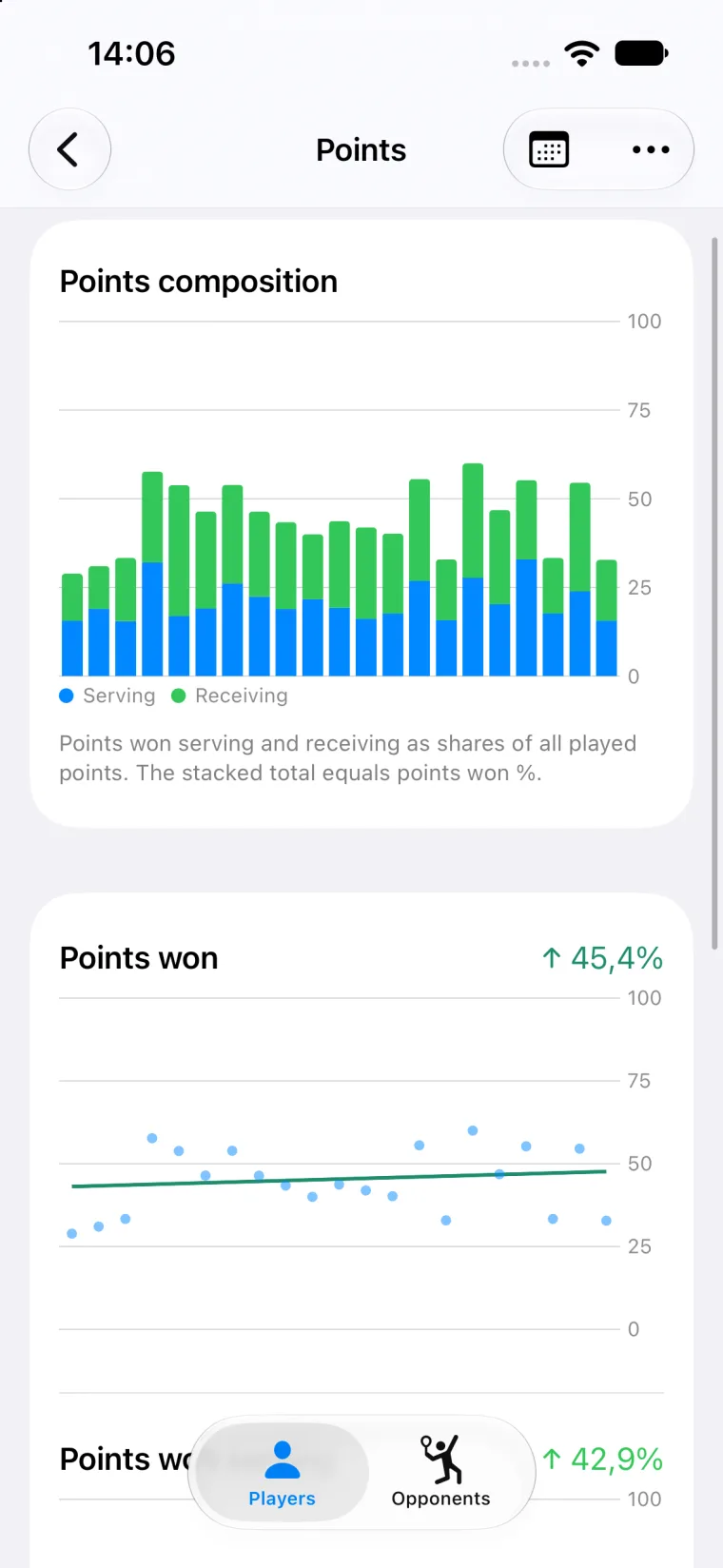
Separate composition from direction.
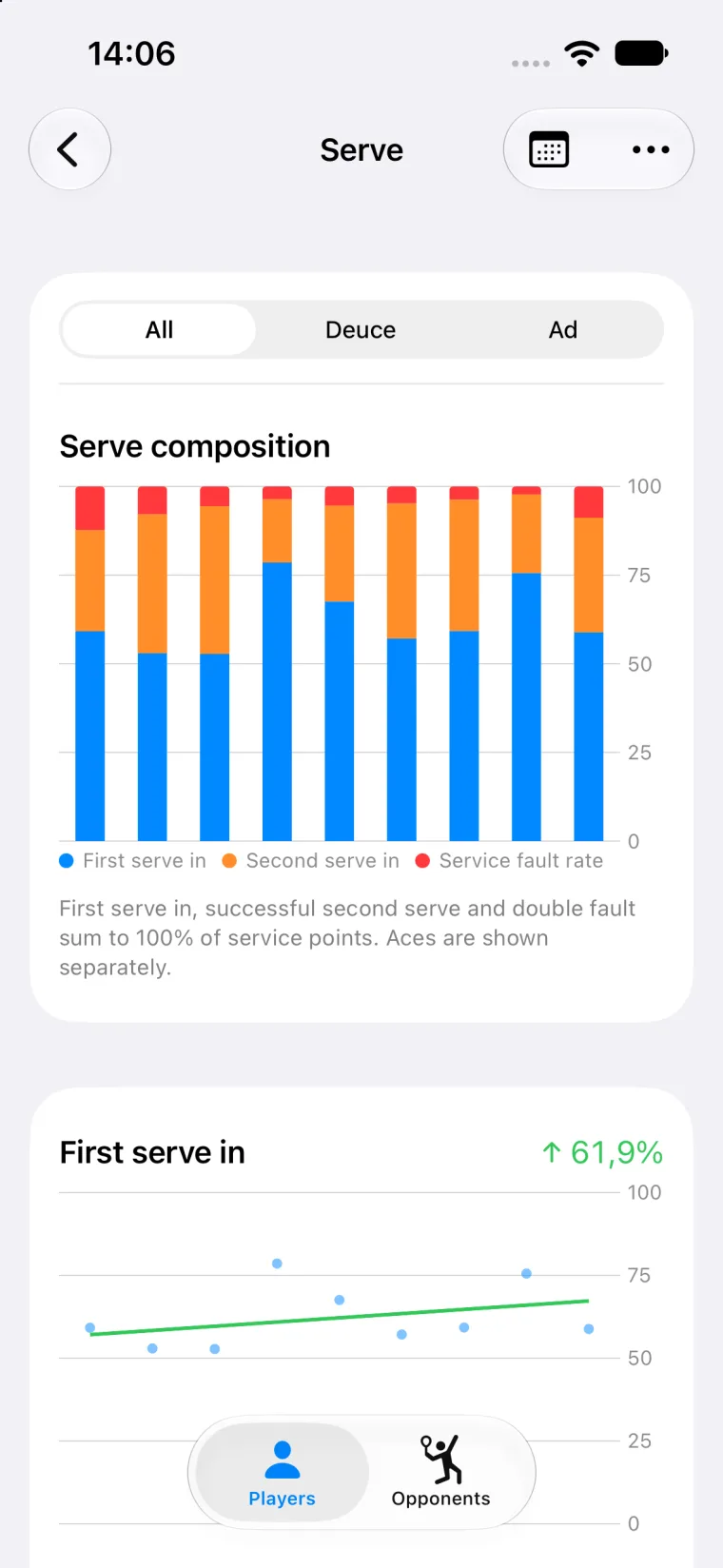
Serve composition shows first serves in, successful second serves and faults for each match. Point composition separates serving and receiving contributions to the total points won. These stacked bars explain what the total contains; the individual charts below them show how each measure changed over time.
Compare sets without inventing a diagnosis.
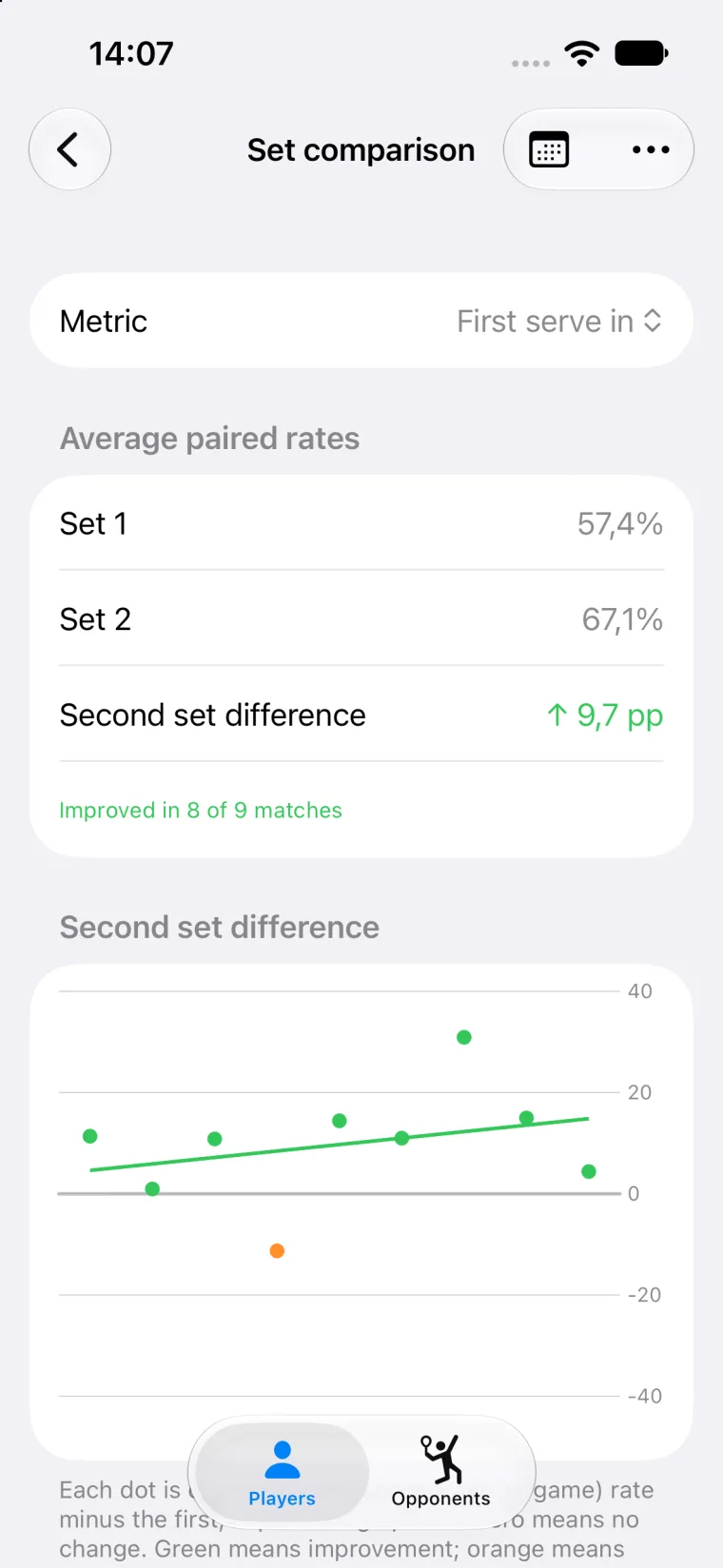
Set comparison places the first and second completed standard sets from the same match side by side. You can choose a measure, see the average difference and review which matches improved, declined or stayed unchanged.
A second-set difference does not prove a slow start, fatigue or a tactical change. Opponents, match situations and sample sizes also matter, so the chart is a prompt to revisit the matches rather than a diagnosis.
Use only the evidence that was actually recorded.
Results and some point measures can be useful with basic point tracking. Serve composition, classified outcomes and other detailed analysis need the corresponding complete evidence. Tennis Doubles and Padel use personal actions only when every advanced point was attributed, without assigning team outcomes to an individual.
Player Development is available for every Match Update sport on iPhone and iPad. Apple Watch, Apple TV, widgets and Live Activities do not show the longitudinal dashboard.
Read a trend as a question, not a forecast.
The lines describe the selected recorded period. They are not predictions, confidence scores or permanent measures of ability. Combine them with match replay, conditions, opponents and the player’s own experience to decide what deserves attention next.